






Diberdayakan oleh Blogger.
Tampilkan postingan dengan label cards. Tampilkan semua postingan

Kamis, 24 April 2014

Is It a Good Idea to Open Multiple Credit Cards for the Rewards?

Is It a Good Idea to Open Multiple Credit Cards for the Rewards?S

Do you ever sign up for a credit card just to receive the reward? Among credit card reward enthusiasts, the strategy of applying for numerous cards in order to earn multiple sign-up bonuses is called credit card churning. But is this a good practice, and can it affect your credit score?

This post originally appeared on Credit.com.

How Credit Card Churning Works

Credit card issuers know that many people can be persuaded to apply for a new card when there is a valuable incentive for doing so. These incentives can range from a discount on that day's purchase, to tens of thousands of airline miles. So-called churners sign up for a new credit card primarily for these benefits, known as sign-up bonuses. In fact, the most dedicated and enthusiastic credit card seekers will sign up for a particular credit card multiple times in order to earn the same sign-up bonuses over and over.

The Challenges of Credit Card Churning

Churning credit cards is not simple, but it is within the capabilities of credit card users who are organized and have a firm control of their personal finances. The first challenge is to find the credit cards with the most valuable sign-up bonuses, apply for them and be approved. To do so, you must have excellent credit and carry little, if any debt.

The next challenge is to keep track of the terms and conditions of each card in order to fulfill them and qualify for the sign-up bonuses. Most credit cards will require that cardholders complete a minimum spending amount within a limited period before receiving the sign-up bonus. For example, the Sapphire Preferred card from Chase currently offers new applicants 40,000 bonus points in the Ultimate Rewards program after they spend $3,000 on their card within the first three months from account opening.

Finally, some card issuers have cracked down on churners by limiting the number of times that a cardholder can receive the same sign-up bonus. For instance, many American Express cards include in their offers this statement: "If we identify you as currently having an American Express Card account, you may not be eligible for this welcome bonus offer." One of the challenges of churning is figuring out these restrictions and working around them.

The Risks of Credit Card Churning

Needless to say, those who have credit card debt, or have trouble controlling their spending should not even consider signing up for reward credit cards just to earn a sign-up bonus. Reward credit cards generally have higher interest rates than comparable cards that don't offer rewards, and those with credit card debt need to find a card with the lowest possible interest rates.

Cardholders without credit card debt still run the risk of making unnecessary purchases in order to meet the minimum spending requirements earn credit card rewards. It doesn't take a cynic to conclude that card issuers are counting on customers increasing their expenditures to earn rewards.

Another risk is that cardholders can damage their credit scores or fail to qualify for a mortgage. Applying for multiple new credit card accounts will add inquiries to your credit report. This will frequently result in small, temporary drop in credit scores for each inquiry; however, the larger amount of credit granted and the increased credit history often benefits churners in the long run. Nevertheless, it would be unwise to apply for many new credit cards in the months leading up to an important loan application such as a mortgage.

If you want to see how credit inquiries are impacting your scores, you can check two of them for free on Credit.com.

Should You Do It?

Some may argue that it is wrong take advantage of credit card issuers by signing up for a credit card just to earn rewards. Proponents of churning counter that the banks choose to make and promote these generous offers, and they are free to curtail or restrict the offers. Furthermore, many churners feel like they are giving the banks a chance to earn their business, and that they may continue to use the best cards, even after the sign-up bonus has been earned. When banks turn a churner into a long-term customer, it is a win-win.

Note: It's important to remember that interest rates, fees and terms for credit cards, loans and other financial products frequently change. As a result, rates, fees and terms for credit cards, loans and other financial products cited in these articles may have changed since the date of publication. Please be sure to verify current rates, fees and terms with credit card issuers, banks or other financial institutions directly.

What is Credit Card Churning? | Credit.com


Jason Steele has worked as a computer systems administrator, a commercial pilot, and a contributor to several of the top personal finance sites as an expert on credit cards and travel. He is a graduate of the University of Delaware with a degree in History.

Images by Openicons (1, 2, 3).

Want to see your work on Lifehacker? Email Andy.


View the Original article

Rabu, 23 April 2014

The Most Overused Startup Pitch Becomes A Super Rare Cards Against Humanity Card

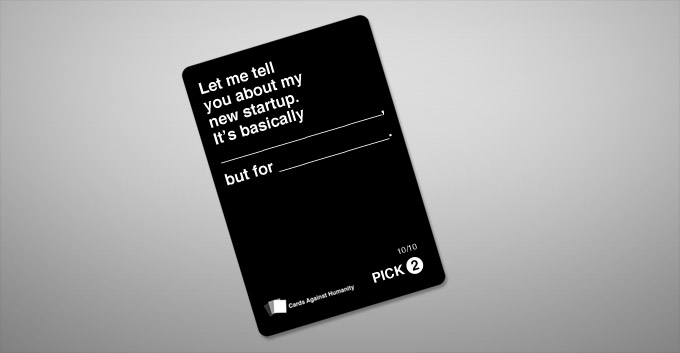
“Let me tell you about my new startup. It’s basically [some popular startup] but for [some completely unrelated thing].”

If you’ve ever been to any startup event, you’ve probably heard it 14 thousand times.

Now it’s a Cards Against Humanity card. The bad news? You’ll probably never see the card in person, because it’s crazy rare.

In case you’ve somehow managed to go this long without playing it, Cards Against Humanity is a self-declared “party game for horrible people.” It began as a humble Kickstarter campaign, only to find a cult following that helped explode the game into a multi-million dollar company. Take the game Apples To Apples, boil it down to its most ridiculously offensive form, and ta-da! Cards Against Humanity.

The game and all four of its expansions have managed to absolutely dominate Amazon’s “Toys & Games” ranks for two years now.

At a panel at the PAX East conference this past weekend, the team behind the game turned to the audience for suggestions for new cards. Many of the ideas were tossed out on the spot; others were worked into something better; some became instant favorites.

At the end of the panel, though, there was a surprise twist: the ten best suggestions of the day were being turned into actual cards… but only for the few hundred people in attendance. An order was sent off to the company in New England that prints their cards before the panel had even wrapped, and each attendee was given a token (hidden under the seat) to let them pick up their set the next day.

Amongst those picked was the all-too-common pitch:

“Let me tell you about my new startup. It’s basically ___________, but for _________.”

Alas, since this card debuted in a way that intentionally makes it rare, it might not ever make its way into an official deck. And since only a few hundred sets were printed, most people will probably never actually see the card in person. You could always use one of the provided blank cards to make your own, but that’s not quite as neat. (“Let me tell you about my startup. It’s like CafePress, but for printing decent-looking custom Cards Against Humanity cards.”)

Other cards picked for printing during the panel include the white cards “What The Rock was really cooking”, “Stepping on a god damn friggin’ LEGO.”, “A floor that is literally made of lava.” and a few others that I probably shouldn’t print on TechCrunch.

Sets from the panel are (of course) already popping up on eBay for around 250 bucks a pop.

Minggu, 20 April 2014

The Efficiency Advantages of Discrete Video Playing cards (Even for Non-Players) 2014

The Performance Benefits of Discrete Video Cards (Even for Non-Gamers)


The Efficiency Advantages of Discrete Video Playing cards (Even for Non-Players) 2014


If you're a PC gamer, you already know that upgrading your computer's video card will give you the most effective gaming performance boost. PCWorld argues, however, that a discrete graphics card belongs in most individuals's desktop PCs-not just gamers.


AMD's and Intel's integrated graphics (graphics technologies coupled with the processor) are pretty capable these days, but they're still far less powerful than discrete video cards when it comes to performance—and not just in games, either:


Games aren't the only applications that benefit from the power of a discrete GPU. AMD's and Nvidia's GPUs are made up of thousands of processors that can carry out multiple operations simultaneously. Any application that benefits from such parallel processing—be it an image-editing program like Photoshop, data-encryption software, or a distributed-computing project like Folding@Home or Seti@Home—will run faster with the assistance of a more powerful GPU.


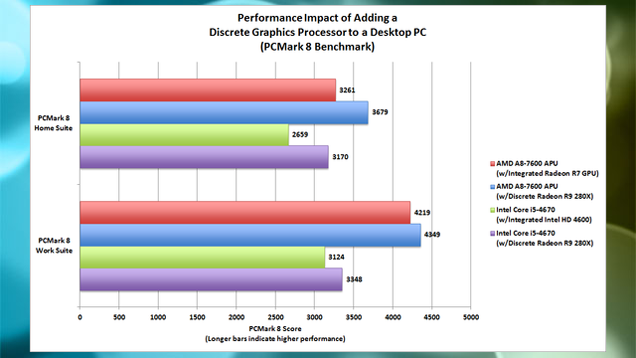
PCWorld's tests show performance boosts of 3% to 19% on PCMark's productivity benchmarks when using discrete graphics cards (a ~$300 AMD Radeon R9 XFX card) versus integrated ones in the same systems. The greatest boosts were for the home suite than the work suite.


Even casual, browser-based games like Farmville and Angry Birds would have significant performance gains (about 1.5 to 2X the performance) from a discrete video card upgrade. The only place they didn't seem to help was in video playback.


Of course, plunking down hundreds of dollars for a new video card won't be worth it if the rest of the system is a bottleneck (an older processor or not enough memory). And there are other upgrades that will give you more bang for your buck, depending on your usage.


The tests suggest, though, that a discrete video card might not be just for gamers. Keep that in mind if you have the cash and are upgrading or building your own desktop PC to future proof it.


Tested: Why nearly every desktop PC could use a video card upgrade | PCWorld


Posted by: http://gosspot.com/

Writted by: totor


View the Original article

Jumat, 18 April 2014

Free Will Sell SIM Cards Using Vending Machines In France

How do you compete with well-established mobile carriers in France, such as Orange, SFR and Bouygues? You automate everything. Free is proving once again that it can remain much leaner than its competitors by replacing brick and mortar stores with vending machines.

Clients will be able to subscribe to one of Free’s plans, pay with their credit cards and get a SIM card. The best part is that the company already signed a deal with Maison de la Presse and Mag Presse stores.

Free will first roll out its vending machines in “hundreds of stores”, but there are 1,700 Maison de la Presse and Mag Presse stores in total. Compare that to Orange’s 1,000 stores across the country, you can see that Free just signed a pretty significant partnership.

As a reminder, Free disrupted the mobile landscape in France by introducing a cheap plan. For $25 per month (€19.99), you get unlimited talk, unlimited SMS and MMS messages, tethering and, even more important, unlimited data with a speed reduction after 3 GB. And there is no contract.

The company was able to do that by staying lean for years. But now, if it wants to get more customers, it needs to become more competitive when it comes to in-store offerings. Yet, building hundreds of stores is expansive and could weaken the company’s margins.

That’s why Free will only open around 50 stores before mid-2015. If you don’t live in a major city, you will have to use the company’s website or these new vending machines. Next step for Free, upselling you with candy bars.

Senin, 24 Maret 2014

Are carrier-free SIM cards on the way?

sim card vodafone

Jonathan Ah Kit

Does the fact that current SIM cards are tied to specific carriers actually benefit anyone other than the carriers? What if device manufacturers like Samsung and Apple could sell you smartphones with SIM cards already in them? Your network connection could change on the fly, or you’d have the option to change it within your account online. OEMs could negotiate better deals for service and pass the savings along to customers. Hybrids combining Wi-Fi and different public and private networks could provide seamless service wherever you went.

Sounds great, doesn’t it? So, what are the chances of it happening?

Is it just a pipe dream?

The news that the Netherlands has eased the rules regarding carrier agnostic SIM cards was picked up by GigaOM and generated a bit of excitement. If OEMs took over as carriers then, in theory, roaming could be eradicated and we could switch to the best service wherever we happened to be. This idea is the “soft SIM” and it’s the kind of thing that gives carriers nightmares. Unfortunately, it’s a fair distance off what the Netherlands legislation is actually talking about.

“This is meant primarily for large scale M2M deployments, think smart metering, vehicles, Kindles, machinery etc. In these cases it is prohibitively expensive to switch SIM-cards even if you could,” explained Rudolf van der Berg, “…it is certainly not for normal consumers and it is not about soft-SIMS. It is about hard coded SIMs that are under control of the M2M deployer.”

A variety of devices now use SIMs for always-on communication

A variety of devices now use SIMs for always-on communication.

Yankee Group 

Rudolf van der Berg is a policy analyst currently working for the Organization for Economic Co-operation and Development (OECD). He has been pushing for this change for years and wrote some of the substantiating research.

So what does the Netherlands legislation mean?

The Netherlands has liberalized the IMSI numbers for carrier agnostic SIM-cards. IMSI or International Mobile Subscriber Identity numbers are unique IDs. They consist of an MCC (mobile country code) followed by an MNC (mobile network code), followed by an MSIN (mobile subscription identification number).

“The Netherlands has so far taken a partial step, by allowing the shared use of 2 MNCs,” says van der Berg.

One of the ways this idea was sold was to highlight the cost involved in switching SIM cards when they are fixed in devices, sometimes even soldered onto a board. As we start to put SIM cards in more devices, from cars to cameras, this issue grows more important.

Give us an example

“Now I do see a role for OEMs but not in the area of mobile phones, but much more in innovations for tablets, laptops, digital cameras and other gear. That equipment often stays at home for long periods, making it uneconomical to buy a monthly data subscription, but when you are on the road or abroad, having access to data would be really really nice. Having to go hunting for a SIM is a chore. Roaming is expensive…” van der Berg suggests, “In such a case a tablet with 3G and embedded SIM registered ASUS, Samsung or something could be really handy. They could provide a function where you buy access on a network or all three networks for X per day, through a simple menu. In addition they could make agreements with providers of Wifi for EAP-SIM authentication even if the tablet only supports Wifi and no 3G/4G.”

sim card

Imagine never having to swap SIM cards again

MIKI Yoshihito

He certainly has a point, and it’s an issue that OEMs really need to tackle. We’ve already seen a move in the US carrier space as T-Mobile offers 200MB monthly free data for tablets if you get a SIM from them. Amazon offered 3G access for Kindle owners for free, but it soon applied a 50MB per month limit. You can still download as many books as you want, but you won’t get more than 50MB a month through the browser. If you want 4G LTE for your Kindle tablet then you have to sign up for a plan from AT&T or Verizon.

People don’t want to have multiple data plans with different carriers, so the ability to switch your service for the SIM in your car or your tablet without having to rip the SIM out is going to be vital.

Indoor call quality

There’s another side to this and it relates to indoor call quality. We’ve all felt the pain of a pathetic signal when we enter a building, sometimes rendering your phone unusable. It’s a serious problem and it can even be a safety concern. Netherlands is a special case here.

“For one or two years anyone can set up a low power GSM network in the DECT Guardband, without any license. Over 3000 organisations have done this so far. For example many hospitals did…” van der Berg explains, “Until now they had no official MNC to broadcast with. This has now been fixed. The benefits lie in improved indoor coverage compared to traditional DECT and to be independent of the mobile network, for example in case of disaster or for the Dutch equivalent of the O2 Arena and Wembley, to make sure that when the stadium is full all the staff can still use their phones on the DECT Guardband and their own PBX (private branch exchange).”

cell tower antenna

Weak signal is still a problem, despite the ubiquity of cellular antennas

 Thristian

In most of the rest of the world we are relying on signal boosters or carrier-supplied devices that effectively draw a stronger signal through your Wi-Fi router or employ Wi-Fi calling to combat poor signals indoors. If businesses and public organizations were allowed to operate their own internal networks, then you can bet a lot of them would.

Where’s the competition?

These moves in the Netherlands are certainly a positive step, but there’s a long way to go. The OECD report on Machine-to-Machine Communications puts it well: “Further liberalisation, in wireless markets, could enable M2M-users to buy wholesale access to mobile networks, to change mobile networks without switching SIM-cards and to directly negotiate national and international roaming…” going on to suggest that, “Such changes could lead to a more dynamic market for mobile wholesale access, mobile roaming and a strengthening of competition between mobile network operators.”

That’s the key right there, how about some genuine competition driving carriers to do a better job? Why can’t we have automatic national roaming, so you get the strongest signal possible wherever you happen to be? Why should the mobile network operators own our SIM cards when it enables them to limit our service, lock us in, and drain every last drop of profit out of us? If the mobile network had efficiency and customer satisfaction as its primary goal it would look completely different than it does right now. You may say I’m a dreamer…

Like this post? Share it!