Diberdayakan oleh Blogger.
Tampilkan postingan dengan label Launches. Tampilkan semua postingan

Minggu, 27 April 2014

La Belle Assiette Launches Its On-Demand Chef Service In Belgium And The U.K.

French startup La Belle Assiette just opened shop in Belgium. La Belle Assiette is a sort of on-demand chef service. You can browse the site, find your chef and book a meal directly from the service — a chef will then come to your home or office. The startup will also roll out its offering in the U.K., Switzerland and Luxembourg in the next six weeks.

Here’s how the service works. Next time you’re having a dinner party at home, you can opt for La Belle Assiette instead of having to cook for 12 persons. You can filter your chef by price, food, popularity and more — chefs range from $30 or $40 per person to hundreds of dollars per person. The chef will buy the ingredients and clean up before leaving.

It’s not a cheap service in any way. Think of it like bringing a fancy restaurant to your home. And it works. La Belle Assiette first opened in September 2013 with 38 chefs. Today, I can find 272 chefs on the website. You just need to book 24 hours in advance, and there will always be a chef available.

In March, the company handled 6 events per day on average in France. The monthly revenue was around $120,000 (€86,000). In other words, the company’s growth is pretty high. The startup raised $480,000 (€350,000) so far. A few chefs are already quitting their other jobs to switch exclusively and go full time with La Belle Assiette. For example, the most successful chef earned $12,000 in March.

When I asked co-founder and CEO Stephen Leguillon why chefs were signing up for La Belle Assiette, he told me that they were looking for a simple platform to advertise, handle their calendars and have an online presence. The startup provides all that, and even handles billing. In exchange, the startup takes a 12 percent cut.

La Belle Assiette just opened in Belgium, and is already working on getting more than 70 chefs in each of its next countries — the U.K., Switzerland and Luxembourg. The startup has a couple of American competitors — Kitchensurfing started out on the East Coast, while Kitchit was created in the Bay Area. La Belle Assiette’s main challenge is to take over the European market before its competitors go international.

Senin, 21 April 2014

PayPal launches Galaxy S5 fingerprint-based payments in 25 countries

Just in time for the world release of the Galaxy S5, PayPal announced the availability of its fingerprint-based authentication system in 25 countries.

First announced at MWC 2014, the system allows PayPal users to log in the app and authorize payments and other operations with a simple swipe over the Galaxy S5’s home button. After logging in, users have access to mobile and online payments at millions of retailers that support PayPal. Using biometric authentication is more secure and more convenient that the traditional credential system because users don’t have to memorize a complex password and don’t have to worry about people nearby seeing their credentials.

Samsung Galaxy S5 is the first phone to integrate the FIDO authentication standard, which is developed by an alliance of tech companies including Google, Microsoft, MasterCard, and Lenovo. PayPal is very keen to reassure users about the security of the payment system of the Galaxy S5:

Customers can use their finger to pay with PayPal from their new Samsung Galaxy S5 because the FIDO Ready software on the device securely communicates between the fingerprint sensor on their device and PayPal’s service in the cloud. The only information the device shares with PayPal is a unique encrypted key that allows PayPal to verify the identity of the customer without having to store any biometric information on PayPal’s servers”
John Lunn
PayPal Developer Network

PayPal also introduced a special app for the Galaxy Gear 2, Gear Neo, and the Gear Fit that lets users check their PayPal balance, receive payment notifications, and even make payments right from their wrists.

If you’re buying a Galaxy S5, PayPal is giving away $50 in a promotional campaign, that you can check by visiting this address  on your smartphone. For some reason, PayPal has not published the list of countries where its new service will be available with the Galaxy S5, but we’ve contacted them and we’ll update this post as soon as we receive an answer.

For more on the Galaxy S5, check out our full coverage.

Sabtu, 19 April 2014

Google Launches Chrome Beta 35

Google today released the latest beta version of Chrome 35. While there aren’t any major new features for end users in this release, the company added a wide range of new functionality for developers to its browser that will make web apps running in Chrome better in the long run.

The features users will likely notice first once developers implement it is support for a number of new properties for touch and zoom input. With the help of the new touch-action CSS property, for example, developers can now disable touch scrolling, pinch-zooming and double-tap zooming on parts of their content. Google says this will give developers more control over the often annoying 300-millisecond click delay on mobile and allow them to create more reliable side-swipe UIs and polyfills of Pointer Events.

For desktop users, the release introduces a system that allows web apps to receive mouse scroll wheel events when the Control key is pressed. Right now, when you use the scroll wheel and hold down Control, Chrome will zoom in and out of the page. For some sites, including Google Maps, that’s not the right behavior, so developers can now invoke other actions based on this input.

Google also unprefixed access to the Shadow DOM in this release. Shadow DOM is an essential feature for Web Components to work. According to Google, it “brings reliable composition of user interface elements to the web platform” and allows developers and web frameworks to “stop worrying about their widgets inadvertently breaking pages by using conflicting CSS selectors, class or IDs, and start relying on DOM as the interoperable way of building components.

Also new in this update is support for a number of new JavaScript features under the ECMAScript 6 standard. JavaScript is the best-known implementation of this standard, and ECMASCript 6 is due for release at the end of the year. Google has already started to implement some of its features, though, including support for things like JavaScript promises (a feature similar to JQuery’s Deferreds), WeakMaps and WeakSets for creating garbage-collected data structures and object.observe for observing changes to JavaScript objects.

This release, however is not just about adding features. Google is also removing a number of features. It’s doing so to simplify its codebase and minimize attack surfaces, but the company says deprecations are mostly about evolving the web API surface “to address the needs of today’s users and developers.” Among the deprecated features in this release are legacy web notifications and NPAPI support on Linux. You can find a full list here.

Image credit: swskeptic under CC BY-SA 2.0 license.

Kamis, 17 April 2014

Transportation Aggregator App RideScout Launches In San Francisco

With the launch of new transportation options popping up in many cities around the country, as well as the digitization of public transit schedules, there are more apps than ever for citygoers to use when they want to get from Point A to Point B.

RideScout seeks to simplify those options, with an app that aggregates multiple options for getting around a city all in one place.

So far, the app has been available in Austin and Washington, D.C., but it’s launching in San Francisco today to give users a view of public and private transit options in the city. In the Bay Area, RideScout highlights options that include Sidecar, Silvercar, Muni, BART, Caltrain, Golden Gate Transit, AC Transit, Blue & Gold Fleet, Baylink Ferry, SamTrans, Flywheel, City CarShare, Bay Area Bike Share, and Scoot.

With those partners on board, users can find transportation options for going between points by bus, train, or car — whether that’s one that’s rented or one that’s been hired. The app allows users to search based on speed and price, among other filters.

RideScout also provides walking or driving directions, and it even integrates with Parking Panda to enable users to get a view into nearby parking options when they arrive.

RideScout might not have all the available options in any given city — it’s still looking to sign up big on-demand transportation providers like Uber and Lyft, for example — but it’s a near-comprehensive look into the real-time availability of many public and private transport services.

Dropbox launches Carousel, a new app for organizing your photos and videos

carousel

It’s a pretty big day for the folks over at Dropbox. First, they introduced both the desktop and Android versions of their popular Mailbox app, and now they are also bringing us yet another new app called Carousel, this time for archiving videos and images.

Dropbox has had the ability to instantly upload and back-up your pictures for a while now, but Carousel aims to perform the same functionality with a little more flair. Carousel promises a system that automatically groups and organizes everything, while storing all snapped photos and videos at their full resolutions.

As you’ll see in the video below, this means it is easy to look back throughout the years, group various pictures and vids, and share them with others. Speaking of sharing, Dropbox says that Carousel has special tools that all your to share your videos and pictures with any phone number or email address, regardless of whether or not the user has a Dropbox account.

Carousel is a free app, though at the moment it has yet to hit Google Play. Dropbox says the app will be arriving later today, so you’ll want to keep an eye of Carousel.com for more details.

What do you think of the Carousel app, like it or do you feel it was unnecessary for Dropbox to spin off this functionality to a separate app?

Rabu, 16 April 2014

MediaFire Launches Desktop Apps, Offers 1TB of Space for $2.50 a Month

MediaFire Launches Desktop Apps, Offers 1TB of Space for $2.50 a Month

We thought Google Drive's price drop was impressive (1TB for $9.99 a month), but, heck, 1TB of space for $2.50 a month is even better. That's what MediaFire is offering now to celebrate its launch of new Windows and Mac desktop apps for syncing your files.

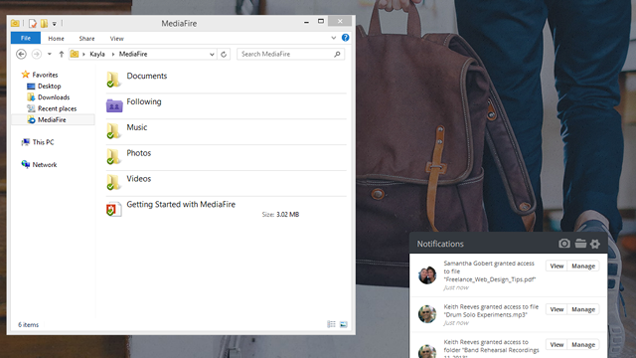
MediaFire is one of our favorite online file sharing services, but previously it was only web-based and you had to drag files to upload them. The new desktop apps (now out of beta) provide a syncing folder like other online storage services do. The desktop apps also show notifications on updated shared files and come with a screen clipping tool to quickly share your screenshots.

Sharing is one of MediaFire's best features. You can "follow" files from other users, track downloads and access to shared files, and also set sharing permissions on specific folders. The file size limit, by the way, is 20GB.

You can sign up for the 1TB plan for $2.50 a month or save a few bucks with a yearly plan for $25. Business plans for 100TB of space are also half off at $24.99 a month. This promotion is good through the summer and, I'm told by a MediaFire rep, that if it's popular (which it seems to be), they'll continue to price it at $2.50. Of course, they recommend you sign up for the yearly plan, though.

MediaFire's iPhone and Android apps are also being updated over the next few weeks to include things like automatic photo syncing.

Read more about the updates at MediaFire's blog or sign up with the link below.

MediaFire via IntoMobile


View the Original article

Selasa, 15 April 2014

500px Launches ISO For Showcasing Its Members, Easier Bulk Upload And Editing

Flickr-competitor and photo-focused startup 500px is launching a trio of new things today, including a new blog called ISO that’s designed to build stories around member photos, revamped upload and management tools, and new collections which are curated photo groups that are designed to provide members with more sources of inspiration.

The ISO blog and the Collections initiative are both designed around the idea that 500px can continue to grow its audience and increase engagement by providing its users with more beyond the photo portfolios that members themselves create for their collections. Highlighting member content in a way that puts choice photos in front of more eyes is a necessary step as the 500px network increases, making it more difficult for any single artist to stand out on the basic Featured images discovery pages that have been part of the network since the start.

The other big change is with backend management tools for users, which mostly make it a lot easier to do bulk upload and editing on the platform. This should help make 500px even more friendly and optimized for professional use, which is a key category for the network since its monetization efforts so far revolve mainly around turning its top content into material that buyers can purchase in physical or digital form and license.

500px previously told me that it would be focusing a lot on the consumer side to spark more network growth, but instead it seems to now be doubling down on supporting pros and aspiring pros with new and upgraded features. It’s a smart strategy given their revenue goals, but we’ll see if this use of more internal content promotion satisfies that want for exposure 500px has clearly identified among users.

Booktrack Raises $3M To Add Soundtracks To E-Books, Launches Classroom Version

E-book soundtrack platform Booktrack is announcing that it has raised $3 million in Series A funding, and that it’s launching of an education-focused version of its platform, Booktrack Classroom.

The idea may sound a little gimmicky, but co-founder and CEO Paul Cameron argued that the combination of music and ambient sound effects can make the reading experience much more immersive — it’s one thing to read that a character was standing on a noisy street, and another to hear the sounds of honking taxis.

The company’s last big launch was for Booktrack Studio, which allows anyone (not just professional publishers) to build e-book soundtracks. Booktrack says that in the five months since the launch, it has drawn 300,000 users to its site and mobile apps, with more than 3,600 Booktracks created in 30 different languages.

Cameron suggested that Booktrack is now pursuing “two distinct verticals”, publishing (including self-publishing) and education. With Booktrack Classroom, students will be able to read, create, and share soundtracked e-books for free.

When it comes to using the technology in the classroom, Cameron pointed to a University of Auckland study that looked at 248 middle and high school students and found that when they read text with a Booktrack soundtrack, they spent 30 percent more time reading and showed 17 percent higher comprehension compared to students who didn’t. (A previous study conducted at New York University found similar results among adults.)

Cameron also gave me a quick demo of the soundtrack-creation process. Users can select the text that they want to enhance, then add audio from a library of 20,000 tracks. (Half of those tracks are owned by Booktrack, while the other half is licensed, Cameron said.) The soundtrack is supposed to adjust to your reading speed.

The new funding was led by Sparkbox Ventures. Booktracks previously raised $2 million from Peter Thiel’s Valar Ventures, filmmaker Peter Jackson’s Park Road Post Productions, and others — the company said those previous investors also participated in the new round.

Senin, 14 April 2014

ePantry Launches An Online Grocery Offering Sustainable Goods, Automatically Shipped To Your Door

A new online grocery called ePantry, publicly launching today, believes that consumers do care about buying green and sustainable products, but they often choose not to because it’s less convenient. That is, when you run out of dish soap or laundry detergent, for example, you simply head over to your local store and grab whatever’s on the shelf – and it might not be the best choice for the environment.

The solution, ePantry believes, is to offer a variety of sustainable household items that are automatically shipped to you on a regular schedule, based on when you’re expected to run out. That way, not only will you have the convenience that comes with shopping online and automated shipments, you’ll also never be stuck buying your household goods from local shops or groceries that may have limited “green” selections.

ePantry - Product Selection

“I really care about the environment, personally, and it always bothered me that people made decisions based on what was convenient,” explains co-founder Stuart Landesberg, who previously worked in consumer and tech investing before co-founding ePantry around 18 months ago.

“I really believe that in 10 years, nobody’s ever going to run out of anything – there’s going to be an anticipatory system that knows that you’re about to pull that last sheet – and it will show up at your door when you need it,” says Landesberg.

He says he started the company under the premise that price was not actually what was preventing consumers from shopping more “green,” explaining that this idea that sustainable products are much more expensive is actually a myth. To be clear, the company isn’t targeting the coupon cutter necessarily, but ePantry’s prices are sometimes even cheaper than the grocery store, Landesberg claims, and they try to have fun with offering discounts, too. For example, right now, you can tell a joke to the people staffing their online chat to receive $2 off your order. (Yes, really).

On ePantry today, there are just over half a dozen brands, including familiar green names like Mrs. Meyer’s Clean Day, Method, Seventh Generation, Green Forest, Preserve, Casabella, and more, but that list is growing, as the service is now expanding into personal care. In total, there are around 400 or 500 SKUs on ePantry at present, Landesberg estimates.

ePantry - Dashboard

The company also recently partnered with Method to deepen the brand’s involvement with ePantry.

Of course, recurring subscriptions for common household goods and other toiletries is something that Amazon offers today with its “Subscribe and Save” program, which lets you automatically replenish everything from kitchen cleaners to shampoos and more. But Landesberg believes there’s still room for a smaller player to scratch out a niche for themselves, given that the CPG (consumer packaged goods) category today is “well under 2% online” he says. “The consumers are up for grabs,” he adds.

ePantry - iOS AppePantry had been running a private beta before quietly opening up to the public at the end of last year, but had yet to broadcast news about its availability, preferring for a softer, more gradual launch. But already the service is seeing some pick-up, with less than a 1 percent attrition rate among customers who have placed their second order on the site, the co-founder tells us.

And while Landesberg won’t detail the size of the current user base, he paints a representative picture, noting that on one day this week the company shipped out 138 orders, and the average order size is around $45-$47, equating to around $200-$300 per year per customer.

The company, also co-founded by Chris Clark, previously Director of Product and Engineering at Kaggle, and Jordan Savage of Goodby Silverstein, has raised $1.4 million in seed funding, mainly from angels.

The investor list includes: John McAtee (VP at Google), Jeff Clarke (CEO of Kodak), Erik Blachford (Ex-CEO of Expedia/Terrapass), Cary Rosenzweig (former brand manager in charge of Tide, ex-IMVU CEO), Taek Kwon (Ex-CEO of Friendster), as well as several ex-TPG Capital colleagues and managing directors at TPG and Toro Investment Partners (where Landesberg previously worked), Fleming Corp., and others.

Now a team of nine full-time in San Francisco, the plan is to grow the site’s product selection and begin getting the word out that ePantry exists to interested consumers.

Minggu, 13 April 2014

Amazon launches Amazon Fire TV to compete with Chromecast, Apple TV

Kris Carlon

Kris Carlon

Putting down roots in Berlin after six years of traveling is a major step for Kris Carlon, who has spent more time living out of a tent lately than sitting at a desk. Kris comes to the AndroidPIT Editorial Team via a lengthy period spent writing on art and culture in Australia and other places he has lived. He joined the Android community while resurfacing in civilization back in 2010 and has never looked back, using technology to replace his actual presence in other people's lives ever since.

Amazon has just announced its very own streaming television service in the battle for your living room, after the weekend's rumor of a Amazon set-top box. Couch commandos can rejoice at the addition of a new service, especially one as well connected as Amazon's platform, Fire TV. The launch cleanly wraps up Amazon's control of content, making their licensing of Amazon Instant Video software to third-party hardware manufacturers like Roku no longer necessary.

AmazonFireTVAmazon Fire TV is officially here to compete for your streaming living room content. / © Amazon

The streaming set-top box setup will bring you not only television and movies, but also gaming. As Google pushes Chromecast, free apps pop up left right and center in the Play Store, and Apple TV continues to expand its empire, Amazon has a nicely thrown down gauntlet to set its sights on. But if anyone knows how to push content it has got to be Amazon.

AmazonFireTVControllerThis is the controller recently seen at a Brazilian regulatory agency, now confirmed. / © Amazon/Anatel

Amazon presented three problematic areas of current devices: search, performance and a ''closed'' ecosystem, clearly taking shots at their competitors in the set-top box world. Fire TV will feature apps like Hulu Plus, Netflix, Crackle and Pandora amongst others. The set-top box features a quad-core processor, 2 GB of RAM and dual-band MiMo Wi-Fi to handle all that buffering, which, incidentally, will reportedly give it triple the speeds of Chromecast, Apple TV and Roku. You can control all that 1080p content with the Bluetooth remote, which you can also talk to for voice search. An average paid game on Fire TV will cost $1.85, and there are over 1,000 free games.

Amazon's Fire TV costs 99 USD and ships today. 

What are your thoughts on Fire TV? Would you prefer Amazon's effort to Google's or Apple's?

Via: The Verge Source: Amazon


View the Original article

Sabtu, 12 April 2014

Kodak Launches A Photo Book App For iPad, Makes Awful “Selfie” Joke

A newly launched photo book application for iPad is bringing a familiar name to mobile photography: Kodak Alaris is debuting “Kodak Moments for iPad,” an app that lets consumers create and order photo books, prints and enlargements using drag-and-drop on iPad.

Competitor Shutterfly should not be too concerned, however.

Kodak Alaris, for those unfamiliar, is the personalized and document imaging businesses group that retained the license to the Kodak brand following Eastman Kodak Co.’s exit from bankruptcy last fall. The company today offers several photography-focused mobile applications for consumers on iOS and Android.

The benefit of using Kodak’s new iPad app is the turnaround time. After building your photo book or ordering prints, you can pick up your creation same-day at a nearby Target or Bartell Drugs store. That’s convenient in terms of last-minute gifts, and the app didn’t throw as many bugs my way as when I tried to use a similar app called Moments shortly after its launch in order to pick up a photo book at a nearby Walgreens. (Walgreens makes an API available to startups, which is both a good and bad thing for its brand, as it turns out.)

However, while the Kodak app is usable, it’s definitely not what one would call enjoyable. The whole experience looks like they ported some dated kiosk software program to the iPad – either that, or some website from the pre-Web 2.0 era. The background is black, with photos falling from the top of the screen to the bottom (flourish!), and generally speaking, the whole application seems as outdated and out of fashion as the Kodak brand itself. What a shame.

screen480x480

Even the App Store description was kind of awful, with the company referring to Yahoo’s Flickr as “FLICKr” (you can grab photos from FACEBOOK and INSTAGRAM too, it says), and included the groan-inducing joke “it’s easy to do it your ‘selfie!’”

I’m serious.

This isn’t just in their App Store copy, it’s, like, their slogan:

blog-600

The photo book prices are reasonable, though, with a 5″x7″ 14-page softcover for $7.99 going up to a 8.5″x11″ double-sided hardcover book for just $19.99. That’s cheaper than Shutterfly, and when I’m being super stingy, I may be willing to squint my eyes to use a terrible-looking app like this in order to save a few bucks.

Nope, probably not.

The iTunes download (for your mom or dad) is here.

Kamis, 10 April 2014

Spotify Launches a New Design on Desktop and Mobile

Spotify launched its biggest ever revamp that spans browsers, desktops and smart devices. Here's what it looks like.

It's been six months in development, but music streaming giant Spotify has now rolled out its new "dark" redesign across desktop and mobile platforms. On the surface, the new Spotify delivers revamped typography, rounded iconography and a stylish theme that's all intended to give your music some visual pop. It's not all bells and whistles, though.

While the functionality you're used to remains intact, Spotify now looks to put content to the fore through its Your Music feature, making it easier than ever for you to find, save and organize your collection, all of which is then seamlessly synced across your devices. Hit the link below to read more, or check it out in Spotify's video above.

Spotify Paints it Black with New Look | Spotify News


View the Original article

Rabu, 26 Maret 2014

AOL Launches Premium Video In UK, With Mainstream Partners Like Endemol, ITN

Today AOL UK launches its ‘AOL On‘ Network in the UK. This is a premium video syndication platform that includes both curated and original content. The UK is the first market outside of North America for AOL On. A dedicated app will be available in the UK in Apple Store and Google Play in early April.

The platform has 750,000 pieces of video. UK content providers at launch include Endemol beyond, Channel 4 News, ITN, Scripps Networks International, MyMovies, Zoom. In and Parentchannel.tv. Little Dot Studios will be providing clips from UK reality shows such as Supernanny and Embarrassing Bodies.

AOL On UK covers news, entertainment, style and tech, and this is distributed through a network of publishers including Trinity Mirror, Telegraph Media Group, TalkTalk, Local World, Videojug and TVGuide.co.uk.

AOL’s owned and operated destinations, The Huffington Post UK, AOL, Parentdish, MyDaily and – of course – TechCrunch, are also part of network.

In the US, AOL On hit the number one spot in comScore’s video category with four billion ad streams, and a billion content streams, in part down to the use of original programming with celebrities such as Gwyneth Paltrow, Sarah Jessica Parker and Nicole Richie.

AOL On is an extension of Be On (end-to-end video platform for brands) and its video trading platform Adap.tv.

Automatic Album Maker Moment.me Launches A New Service For Mobile Event Websites

Apps that help users make sense of their ever-growing photo collections through automatic organization and curation would seem to make sense, and offer a service people need. But over the past year or so, we’ve seen these types of startups fail, pivot or simply stagnate. Everpix is no more, for example. Tracks shifted, launching a new app called Kanvas for photo-editing. Flayvr has yet to see mainstream adoption.

And today, Tel Aviv-based startup Moment.me joins the fray, with a new business that sees it distancing itself from the automatic, social photo album space, with the launch of a new service focused on building mobile websites for events.

These “microsites,” as the company calls them, are meant to serve as online pop-up shops for events, including things like concerts, sporting events, film festivals, and more. Today, information about an event can be found across the web, on the sites belonging to the artist, the band, the promoter, the sports team, the venue itself, and on blogs and social media, Moment.me co-founder Eilon Tirosh explains.

The new microsite creation service essentially repurposes Moment.me’s aggregation technology for this (the team hopes, eventually profitable) new venture, allowing event organizers, bands or teams to quickly launch a mobile website that serves as the hub for everything there is to know about the event in question.

Screen Shot 2014-03-24 at 9.53.10 AM

The idea is to make building the microsite as simple as using any other consumer-facing service, with no coding required. After entering in the event time and location (or pulling in those details from a Facebook page), the service then pulls in the top content from social networks including Facebook, Twitter and Instagram, while also allowing for further customization, like adding maps, details on where to eat or drink nearby, links to ticket or merchandise sales, sharing features, and more. The resulting sites work well on any form factor, whether desktop/laptop, tablet or mobile phone.

While the basic microsite builder will remain free, over time, the company plans to introduce premium features for commercial events that will allow for additional customization or levels of engagement. Moment.me is also in discussions with others in the event industry, like ticketing companies for example, for further integrations.

Screen Shot 2014-03-24 at 9.50.57 AM

Site creation is currently available online, though the company notes it will also be offered within the Moment.me iPhone application.

Moment.me was founded in February 2012 in Tel Aviv by Ronny Elkayam, Eilon Tirosh, and Boaz Adato. It has $1.5 million in seed funding from Blumberg Capital and other private investors.

Google Launches Photowall, An iOS App For Beaming Collaborative Galleries To Chromecast

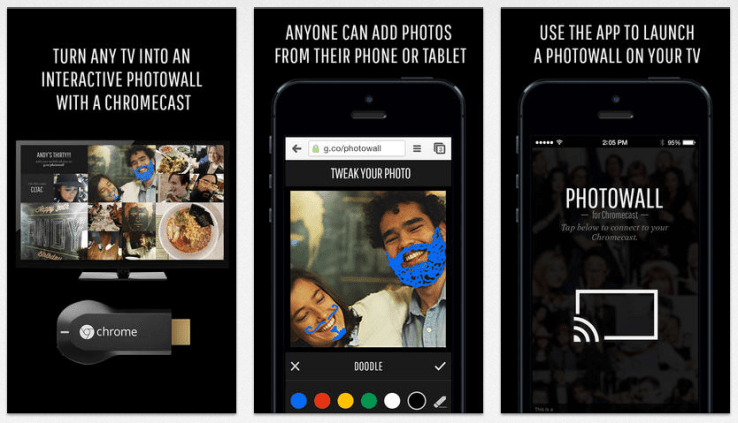
Google has launched a new iOS app with Chromecast-specific features called Photowall. The app, as detailed by 9to5Mac, lets users send photos from their device to their Chromecast-connected TV, and works with either one iPhone user or a group on the same network. There are also photo editing features that let you doodle and make notes on images displayed on the big screen. Finally, the app can generate a YouTube montage from your photo wall creation for easy sharing.

Others participating in the fun don’t even have to have the app installed – they can add photos from their phone or tablet using a web-based interface, as well as doodle or add annotations. It’s iOS-only for now, but I’d expect this app to come to Android, too. This seems like a fun take on the slideshow of old, and a more participatory version that hopefully isn’t quite as boring as sitting around watching vacation photos passively.

The Chromecast is Google’s $35 TV streaming connected dongle, for those who haven’t yet caught wind of the mobile accessory. Google recently expanded its availability, so more people around the world should be able to take advantage of new software that comes out for the streaming stick. There’s also a powerful third-party API for the gadget, but it’s good to see Google still exploring first-party apps for its pet media project, too.

Selasa, 25 Maret 2014

Unbabel Launches A Human-Edited Machine Translation Service To Help Businesses Go Global, Localize Customer Support

Today, you can be anywhere in the world in a matter of clicks. Thanks to globalization and the plucky old Information Superhighway, our world is shrinking. Inquisitive globetrotters can pop over to Google Earth, pilot through volcanoes in Hawaii or navigate a few Norwegian fjords and still be home for dinner. Vasco de Gama? Not impressed.

The sheer number of people not only coming online but shopping, watching, learning and consuming online — from every corner of the globe — is staggering, and every business wants to take advantage. Businesses now know they need to be where their customers are and that they can’t be one-size-fits all if they hope to thrive in today’s global marketplace.

The problem, of course, is that their new, global customer rarely seems to be speaking the same language. Not surprisingly, translation remains a big, expensive problem for businesses today. Most companies recognize the importance of localizing their websites and content, but few have the time, money or inclination to go one step further and localize that rapidly updating content or section of their site, their FAQs or their customer service interactions.

For most sites, these last two points, especially, are usually what break the budget — for those lucky (or smart) enough to even have a line of the budget dedicated to translation spend. This is where Unbabel wants to help. The Y Combinator-backed startup is launching today with a new kind of online translation service that aims to make it easy and affordable for a business of any size to translate all of its online content — from marketing collateral and FAQs to customer service emails, both static and dynamic.

To save businesses from breaking the bank on translation services, Unbabel has developed technology that combines machine learning-based auto-translation with crowdsourced editing to offer quality translation at what it claims is “one-fifth” the going rate. By contracting Unbabel directly or by using the company’s REST-based API to integrate translation directly into their workflow, businesses can translate all of their website’s content in a flash at $0.02 per word.

Now translating over 30,000 words/day for over 30 customers, Unbabel’s secret sauce leverages artificial intelligence software and its stable of over 3,100 editors (or translators) to translate a website’s content from one language into its customer’s language of choice. First, its machine learning technology translates the text from source into the target language, at which point it uses its Mechanical Turk-style distribution system to assign editing tasks to the right translators, who then check the translation for errors and for stylistic inconsistencies.

Unbabel editors work remotely, via their laptops or mobile phones, on translations, which co-founder Vasco Pedro says provides the key to faster translations. This, combined with the efficiency of its task distribution and administration algorithms, provides a level of efficiency that allows editors to earn up to $10/hour working for Unbabel.

The startup is also hoping to appeal to businesses looking to cater to international customers not only by offering integration through its REST-based API or by allowing them to quickly fill out their online form to order translations, but by offering email-based translation as well. To help with international, localized-style support, Unbabel offers businesses the ability to provide customer support in a customer’s native language via email as well at $3 per 150 words. Businesses can simply send an email to a language-designated inbox it sets up with Unbabel, and the company will reply with a translation in less than an hour.

Beyond email, Unbabel also offers a separate pricing tier for FAQs, which allows businesses to translate their user’s comments (and their own) so they can follow all the whole conversation on their website at $5 for every 250 words. In turn, businesses can use the startup’s translation technology to translating their social streams, as Unbabel will convert each tweet, post and comment into their language of choice at $1 for every 50 words.

This means that businesses can send Unbabel what they need translated online, through its API or by email, which the company then converts into micro-tasks, automatically translating the source and turns over to its community of editors to refine. The content is then delivered, recombined and translated in near real-time. Today, the startup supports nearly 14 languages, including English to 13 other languages, or nearly any combination thereof.

However, co-founders Vasco Calais Pedro, Sofia Pessanha, João Graça, Bruno Prezado Sliva, and Hugo Silva tell us that they’re working to add more languages to its roster, and hope to begin supporting new languages over the course of the coming year.

fTranslate your user’s comments and your own, follow all the conversations on your website.

Unbabel helps you provide customer support to your international customers in their native language. Just send an email to a language designated inbox and Unbabel will reply with a translation.

Unbabel editors work on their laptops or mobile phones, this is key to faster translations.

irst, state-of-the-art artificial intelligence software translates the text from source to target language.

For most sites the last two of these especially can rapidly break any budget set aside for translation. Unbabel intends to change this using sophisticated technology that combines machine learning based auto-translation and crowd-sourced post-editing. This latter also uses machine learning to optimize the set of editors applied to a job.

Combining auto-translation and effective human editing as a service is unique and new. With Unbabel, for the first time it is now affordable for a website to translate all of their content, both static and dynamic, from marketing to FAQs, to customer service emails.

Unbabel also has released a REST-based API with which companies can integrate translation directly into their workflow. The company is growing rapidly and currently has nearly 2600 translators and are translating over 25,000 words per day for over 40 paying customers.

Unbabel was founded by Vasco Calais Pedro, Sofia Pessanha, João Graça, Bruno Prezado Sliva, and Hugo Silva. They have raised funds from Y Combinator, YCVC, Faber Ventures and Shilling Capital Partners. With over 700K words translated thus far and over 40 paying customers, Unbabel has raised just over $400K to date from Y Combinator, YCVC, Faber Ventures and Shilling Capital Partners.

For more, find Unbabel at home here.

Screen Shot 2014-03-23 at 2.48.44 PM

Jumat, 21 Maret 2014

Style Lend Launches Out Of Y Combinator To Be The Airbnb For Women’s Closets

Collaborative consumption marketplaces have taken off in recent years to let people share many of the big ticket items in their lives: houses, apartments, cars. A new startup called Style Lend is gunning to be the go-to site for sharing the big ticket items that are sitting in women’s closets.

Essentially an Airbnb for high-end dresses and accessories, Style Lend is a peer-to-peer marketplace where women can list and rent items for a fraction of their original retail cost. Most women can relate to having at least a couple items in their closets that cost a lot of money, but get very little wear: That one special occasion dress, or designer handbag. These kinds of items stick around because they aren’t quite candidates for consignment. She loves them and wants to keep them, but the truth is that they stay in the closet 95% of the time.

How it works

Much like Airbnb, Style Lend’s purported edge is in the convenience and assurance provided by its added services. For the dress lender, there are two levels of Style Lend’s service: DIY, where the lender gets 70 percent of the rental cost, and “on demand,” where the fee is split 50/50 and Style Lend takes care of details like the dry cleaning before the items are returned. Lenders can also pay $5 for insurance that will handle issues such as small stains, broken zippers, and ripped fabric.

A dress available for rent in San Francisco on Style Lend.

A dress available for rent in San Francisco on Style Lend.

Style Lend CEO Lona Duncan came by TechCrunch headquarters to explain the service and show us the kinds of dresses it offers in person. You can watch that in the video embedded above.

Duncan says that Style Lend is meant to be a win/win transaction: The dress owner gets to monetize the “investment pieces” in her wardrobe and show off her taste to the Style Lend community. The borrower gets to sport a stylish dress or designer purse at a fraction of the price it would take to own it. The site is meant to be a true marketplace, where renters are also borrowers, and vice versa.

The dresses in Style Lend’s “high end designer” category have an average retail value of $2,155, and cost $120 per week to rent. Style Lend requires that each dress on its site have a minimum retail price of $150. Dresses at that “cost-conscious designer” level are rented out at an average price of $30 per week.

Right now Style Lend is only in San Francisco, but it plans to roll out in New York City and other metro areas in the coming months. The company is currently in the winter 2014 class of Y Combinator, which is scheduled to hold its Demo Day next week.

The bigger picture

Fashion may seem like a frivolous space, but it’s a massive industry that has a big impact on the world.

Nowadays, more and more women want to keep up with trends and experiment with different looks. But many can’t justify investing a lot of money on items that they’ll wear only a couple of times. That’s led to the rise of disposable “fast fashion,” which has negative repercussions on human rights and the environment.

If it takes off, Style Lend could help to counteract this shift by encouraging women to buy fewer, better things. If a woman knew that she could share an item with others and make money on it, she might choose to buy the $200 silk Amour Vert dress that’s responsibly made in the U.S., instead of the $40 polyester Forever 21 dress that’s made in a factory with questionable low-cost labor practices. It’s an optimistic vision, but Style Lend has the potential to make it a reality.

Medium Launches Simple iPhone App That’s Just For Reading

Blogging platform Medium has released a simple app for the iPhone that allows users to read articles from the site. They’re presented as a feed that’s recommended for you automatically, though articles that have been recommended by people you follow feature their mug shot next to the title.

The app does not, in its current incarnation, feature any writing or composition features — this is for reading things on Medium only, not creating them.

IMG_4968

Twitter co-founder and Medium creator Ev Williams has posted an article about what the Medium app is about, and he says that, after consideration, the team decided to produce an app created just for reading.

“When we started working on this six months ago,” says Williams, “we debated a lot about the purpose of the app. Was it just for reading? Should you write on it? If just for reading, what would be better about it than just using the mobile web.”

The differences, says Williams, came in the details. Things that allowed them to make the articles display faster and that let them improve the layout. Things that made it “better than the web” in terms of reading experience.

When you launch the app, you’re asked to sign in with your Twitter account. Then you begin reading. IMG_4971

There is no index of your feed; you simply swipe to move backwards or forwards through articles. The app does include a simple feed of stories in a given Collection, however. Tapping on a collection name either at the top or bottom of an article will take you to this view. But that’s the only way to navigate around the various components of Medium. Otherwise the app is an exercise in restraint, presenting an extremely focused way to read, just read, Medium.

Tapping on an author will give you a similar list of just the stories they’ve written.

There will no doubt be a few folks who are confused by the lack of editing tools in the app — at least to start. But I think it’s admirable to focus on offering the best reading experience possible, rather than trying for a breadth of features done “just well enough.” It also speaks to the expressed desire of Williams and his team to move us away from “news bites“ and toward pieces that consider things more deeply.

I did experience a couple of crashes within the first few minutes of using the app — especially when navigating to a category via the link at the bottom of a post. But hopefully those are just launch-day jitters.

Medium has garnered a bit of a reputation for harboring pieces that are … less than self-aware. And multiple times over the past few months, it has been host to this or that controversial take on life, the universe and everything. The alternative, though, is for it not to be talked about at all — so I think we know which one they’d choose.

Anyhow, Medium aficionados now have an iPhone app that reflects the clever and crisp design work done on the website itself — though it’s only for looking and liking, not writing. No word on an Android client.