








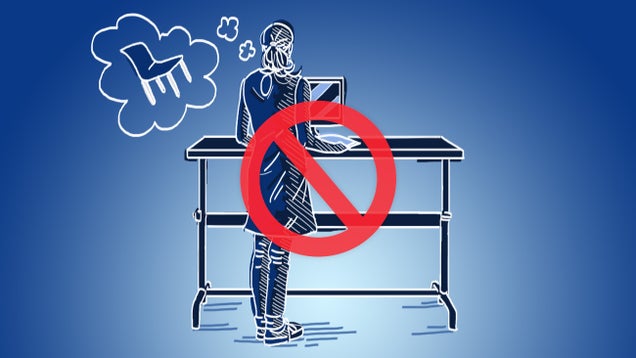
Standing desks may be all the rage, but they certainly have their downsides—and they aren't for everyone. Writer Mikael Cho explains why he ditched his standing desk, and how he combats the unhealthy side effects of sitting all day.
This post originally appeared on the Crew Blog.
I was in. I always wanted a standing desk. I heard the benefits. And read the studies. The American Cancer Society tracked 123,000 people for an 18-year period and found the death rate was higher in people that sat more than six hours per day.
In another study with over 200,000 participants, researchers noted that even active people (those who exercised for at least five hours a week) had an increased risk of death if they sat longer. There was even one test done by a company that showed standing desks improved productivity by up to ten percent.
With all of this research pointing toward the benefits of getting out of your chair, I was eager to give standing a shot. When we moved into our new office for ooomf, I created my dream workstation. The focal point would be my standing desk.
What Happened
Late one night, I finished building my standing desk. I assembled it from 22 dollars worth of IKEA parts and after I drilled the final hole, I felt like a proud new dad.
I stood working for the first time — an hour and half with my bare feet planted on a yoga mat. I felt strong. Powerful.
The next day I came in to the office ready for a day of standing. I stood solid for about an hour before my legs got tired. My back and shoulders started to cave in, but I fought. I squeezed my shoulder blades together, pushing against gravity — which now felt like a particularly powerful force.
Even though I was fighting some pain, I thought it was good pain , like the pain you get when you're building muscle when you workout. It felt like I was training my muscles for better posture and this was all part of the process.
After about two hours, I took a break. Sitting felt like greatest invention ever.
When I felt my legs were ready for another round, I stood up to work again. This time, however, my legs and posture started to fail within about twenty minutes. As I was standing, I couldn't help but bend over to stretch my back or lean on one leg to give my other leg a break.
I had to sit and work from my laptop for the next few hours. I was able to get up and work a bit more from my standing desk but I started to look at my standing desk differently that day. It was becoming a place where I didn't want to be rather than a place I looked forward to.
Still, I thought this was all part of the training and my body would eventually get used to it. So I continued. After two weeks, I was able to stand for about four hours a day, but I still needed to take multiple breaks. This was fine with me because I often need breaks throughout the day to refresh and maintain a good flow (and after all, having a standing desk doesn't mean you need to stand for the full 8 hours).
The problem with my standing desk, however, was it forced me to rest at times when my brain wanted to work. It was hard for me to get into a "flow" while standing.
The standing desk helped me stay focused for certain tasks like answering email (partly because I knew I could only stand for so long). But when it came to tasks that required a bit more focused thought, like writing, I was distracted. I thought more about the pain in my legs than the words I was trying to put on the page.
Even if this pain was good for me, I didn't care anymore. Thinking about the pain was impacting my work. That day, I killed my standing desk.
Although I may be missing out on the potential health and productivity benefits, a standing desk wasn't necessarily helping me do better work. And better work is the main priority for any desk I create.
When words are flowing, leg fatigue shouldn't cut a writing session short. When I'm "wired in," I don't want to have to think about the discomfort in my lower back. I just want to think about my work.
I do enjoy being active everyday. It makes me happy. And although a standing desk didn't work for me, I found there are many other effective ways to be more active during the day.
Is Sitting Really the Smoking of Our Generation?
In the last few years, several researchers have deemed that in certain ways, sitting is the smoking of our generation. This is partly due to many jobs being converted into sitting behind a screen, which means people are sitting for much longer today than they did a generation ago.
But the reality is, sitting isn't bad. It's sitting for long periods of time without movement that's the killer. In fact, staying in pretty much any position for too long isn't healthy.
In many of the studies about the negative effects of sitting, researchers are pointing toward regular physical inactivity as the problem. When we don't move, our risk of cardiovascular disease increases and our blood circulation drops along with the production of enzymes in our bodies that burn fat.
A standing desk may be one way to solve the sitting problem but it doesn't solve the inactivity problem. Standing is not necessarily better than sitting if you do it for a prolonged period of time. Sure you may burn a few more calories but standing for long stretches can lead to things like poor valve functioning in the veins in the legs (i.e. varicose veins) and pressure on the knees, reducing lubrication, which can cause tearing.
So it's not whether we sit or stand. It's about activity.
And although intense exercise can be good for your health, the baseline activity required to live a long healthy life doesn't have to be much. National Geographic researcher Dan Buettner notes, you don't have to run marathons or be a professional athlete to add quality years to your life.
Buettner and his team have been studying areas called Blue Zones, where people are leading the longest, healthy lives on the planet. The funny thing is, most of the people in these communities don't exercise in the way that we think of exercise Buettner says. They eat a plant-based diet and have a support network of people they can lean on throughout life, but they don't go to the gym. They don't hop on a treadmill. Instead, they perform regular, low intensity physical activity because of the way their lives are structured.
One community in Okinawa, Japan has one fifth the risk of colon and breast cancer and lives seven years longer than the average American. In their culture, people sit on the floor, causing them to get up and down thirty to forty times per day.
Another village in Sardinia, Italy has ten times the number of people living to over one hundred than in America. They live in vertical houses, so they must go up and down the stairs. Their land is infertile, which requires them to tend to it, requiring regular, low-intensity physical activity.
In each of these communities, walking is typically the default mode of transportation. Buettner states that walking is the only proven way to push away cognitive decline and constant, low level activity is one core factor to living a long, healthy live.
Buettner's findings have been backed up by a study done in the United States that tracked the walking behavior of 300 participants over a 13 year period. Those who walked the most, cut their risk of potential memory problems in half. The researchers concluded that 9 miles a week was the optimal distance for neurological exercise.
If you enjoy working out or going to the gym, that's awesome. Exercise can make you stronger, happier, and add years to your life. But if you can't find time to exercise consistently or you've got injuries that prevent you from training, there are other ways to get the baseline activity level for what your body needs.
How to Not Die from Sitting Too Much
So walking is one answer to introduce more activity in your day. But sometimes you can't leave the office for a walk. Maybe the weather sucks or you've got a tight deadline and need to stay put until it's done.
Here are three simple things you can try to boost your activity when you can't leave the office:
Work with your feet up. There are ways you can design your desk to help your posture and improve your circulation even if you're sitting for most of the day. Working with your feet up while sitting has been proven to improve circulation in your legs. Research also shows that adjusting your chair to adjust to about 135 degrees reduces the pressure on your back from sitting in a chair for long periods.

I've got a good chair that adjusts freely to 135 degrees and I've added a foot rest from IKEA to help with circulation in my legs:

Do air squats. Air squats are one of the best ways to release enzymes that breakdown the production of fat in your body and improve circulation in your legs. Don't worry about changing into workout clothes. Do as many air squats as you can while you're waiting for the microwave or your coffee. Even the city of Sochi in Russia recognized the health benefits of air squats. When they hosted Olympics, the city offered a free train ticket in exchange for thirty air squats:
Stretch your hips. When I started training at my gym, I couldn't do a proper weighted squat. My lower back would hurt and I couldn't drop by butt lower than my knees. My trainer told me that my hips were tighter than a lid on a pickle jar.
Why? I learned that many of the muscles surrounding your hips are connected to muscle tissue in your lower back. If you're like me and have been working at a desk for a few years, the muscles in your hips are likely so tight they can create pain that resonates in your lower back.
Tight hips are often the underlying culprit leading to lower back problems and issues with mobility as we get older. One of the best ways to loosen up your hips is to stretch your hips once a day.
Kelly Starrett started one of the first Crossfit gyms in 2005. After working with tens of thousands of athletes, he noticed constant mechanical problems athletes were having when trying to do certain exercises like squatting. Starrett designed a program to hack your body's mechanics, to help the body relearn proper movement mechanics, which prevents injuries and enhances athletic performance. Here's three stretches Starrett recommends to increase hip mobility. I try to do these stretches daily. They take about three minutes a day but can help reduce the potential for back problems for life:
If a standing desk works for you, that's great. But if it doesn't, don't force it — especially if it negatively impacts your work. Standing while working might not be for you. It wasn't for me. And that's okay. Standing for long periods of time isn't much better than sitting anyway.
The key is to do some activity every day. It doesn't have to be a five-mile sprint. A walk to and from work, taking the stairs, or some squats while you're waiting for your lunch can be enough to do the trick.
Why I Killed My Standing Desk | Crew Blog
Mikael Cho is the co-founder of Crew, a creative marketplace connecting mobile & web projects with vetted, handpicked developers and designers. Mikael writes more posts on psychology, startups, and product marketing over on the Crew blog. Find him on Twitter @mikaelcho.
Illustration by Tina Mailhot-Roberge.
Want to see your work on Lifehacker? Email Andy.
Don’t forget to leave your feedback under and observe us on Twitter or grow to be our Facebook fan for all the most recent updates!
Posted by: http://androidframes.blogspot.com/
Writted by: totor